What is the use of not knowing?
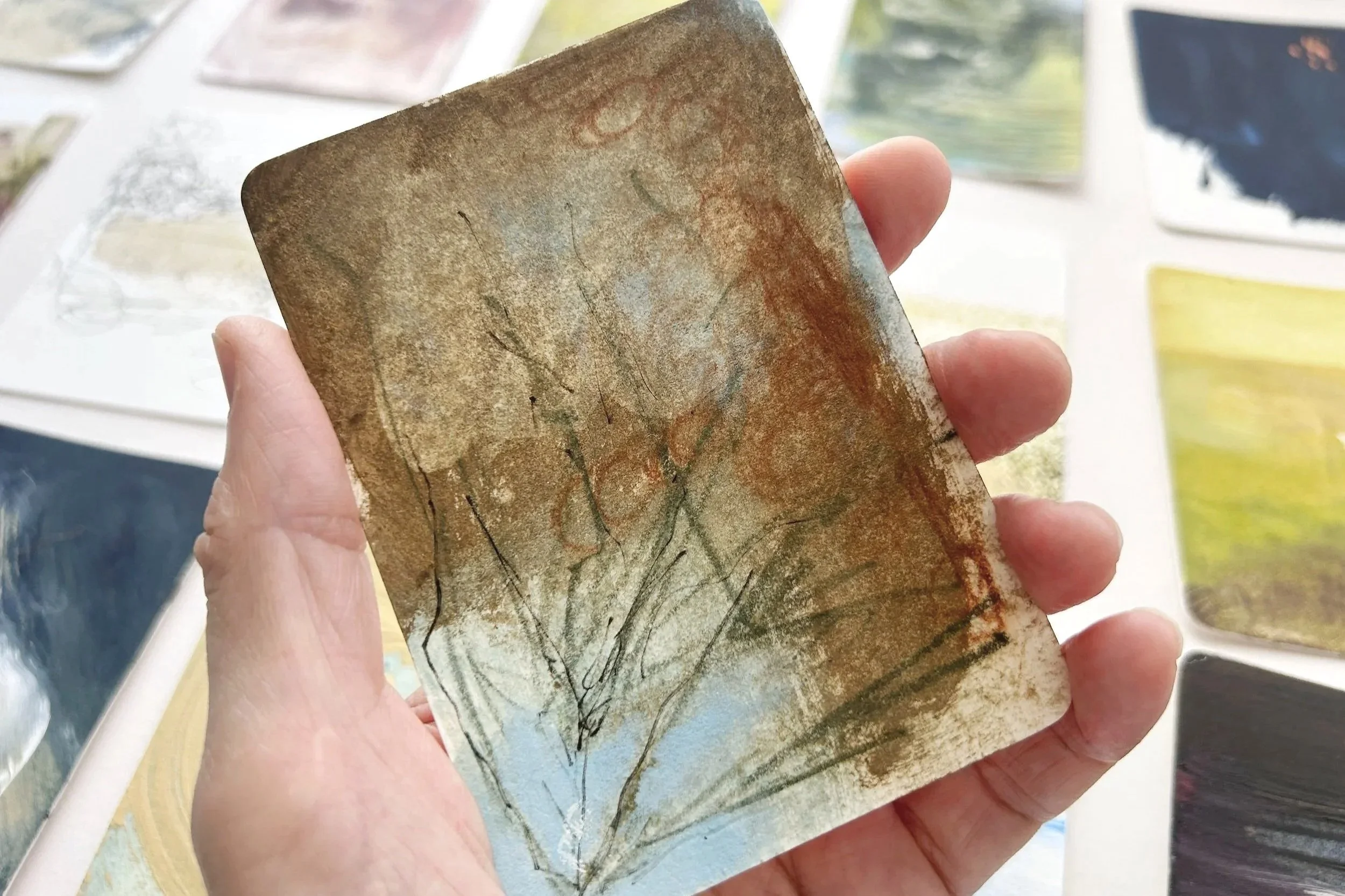
No Clear Weather, a handmade card from Listening Fields
I have been thinking about not knowing.
Not the kind you can solve with a little more information. More like the periods in life when the weather really is unclear. When we are living inside something and do not yet have enough distance to understand what it means, where it is going, or what happens next.
I haven't always been very good at this.
Like most of us, I have often wanted to understand what was happening so that I could do something about it. Find the reason. Make a plan. Fix the problem. Know what comes next.
All of those things are useful. I wouldn't want to live without curiosity, knowledge, action or change.
But I have begun to wonder what happens when we reach for them too quickly.
Sometimes we know only a small part of what is happening, yet begin building a whole story from it.
A difficult day becomes a setback.
Something that hasn't happened yet becomes something that will never happen.
A feeling becomes evidence.
Uncertainty itself becomes a problem to solve.
We stand somewhere in the middle of our own lives and mistake the view from there for the whole landscape.
Staying a little longer
In the past few years, through periods of uncertainty, problems with my health, anxiety, making, and ordinary days, I have been drawn to what happens if I don't ask an experience to explain itself straight away.
This doesn't come naturally to me.
And it isn't passive.
There's a difference between doing nothing and not deciding too soon what something means.
Sometimes action is necessary. Sometimes there is a problem to solve, information to find, treatment to seek, a decision to make or something that really needs to change.
But not always immediately.
Sometimes the most truthful thing I can say is:
I do not yet understand.
I've come to like the yet in that sentence.
It leaves the door open without making a promise.
It doesn't say that everything happens for a reason. It doesn't promise that difficulty will eventually reveal itself as something worthwhile, or that if I am patient enough the whole story will make sense.
Perhaps tomorrow I will see something I cannot see today.
I may understand it differently in a year.
Several things may turn out to be true at once.
Perhaps I will never have a particularly satisfying explanation.
For now, this is where I am.
Working with what is here
I've noticed something else.
When I stop insisting that things must be different before I can be all right, something sometimes softens at the edges.
Not necessarily the thing itself.
The uncertainty may still be uncertain.
The difficult feeling may still be there.
The problem may still need attention.
But some of the struggle around it can become quieter.
Fear has a way of asking us to live a little way ahead of ourselves. It wants to know what happens next, whether this will get worse. Whether something will return. Whether we are making the right decision. Whether we will be able to cope.
These are understandable questions. Sometimes answers are available and worth seeking.
Sometimes they aren't.
There have been times when I tried hard to make uncertainty disappear. Slowly, I found another way to meet it.
Not:
This is fine.
Not:
This doesn't need to change.
Not even:
Everything will work out.
More simply:
This is what is here.
Can I work with what is here today?
There will be another day to look again.
That doesn't mean tomorrow will be easier. It doesn't guarantee anything.
But for me, loosening the demand to know what comes next has sometimes loosened something else too. The fear around not knowing. The sense that everything must be understood or solved now.
The edges become a little less hard.
More room around the problem.
And from there, it can sometimes become easier to see what actually needs doing.
I haven’t stopped caring about change.
I am no longer asking change to happen before I can meet the life that is already here.
A field holds conditions
This is where the idea of a field began to become important in my work.
A field receives whatever weather arrives.
Rain crosses it. Wind moves through it. Ground dries. Grass bends. Light changes. Something grows. Something disappears. Something returns.
None of this has to become a judgement about the field.
The field holds the conditions in which life is taking place.
That became a useful way for me to think about experience too.
Instead of immediately asking, What is wrong? or What does this mean?, I can sometimes ask:
What are the conditions here?
Am I tired?
Is there too much noise?
Perhaps something genuinely is uncertain.
Am I frightened because I don't know what happens next?
Is there support beside me that I hadn't noticed?
Is something small beginning to return?
Today may be different from yesterday.
Context matters. Conditions matter.
Recognising them doesn't solve everything. It just gives me a wider field to see what is happening.
This has become one of the foundations of Listening Fields:
A field holds conditions.
Not conclusions.
It can hold difficulty without turning it into failure. It can hold ease without turning it into a promise. Uncertainty, connection, absence, growth, interruption, warmth, change. All can be present without deciding straight away what any of them mean.
Listening before understanding
Ways of making sense of ourselves surround us.
We name things. Search them. Measure them. Ask other people. Ask experts. Read books. Look for patterns. Increasingly, we can ask an algorithm almost any question the moment it occurs to us.
I do these things too.
But information and understanding aren't quite the same thing.
Sometimes understanding needs time.
You can look at a painting before you interpret it.
You can walk across a landscape before you map it.
You can notice a feeling before you explain it.
A question can remain open long enough for more than one possibility to exist beside it.
This is what I mean by listening before understanding.
Not abandoning reason.
Not distrusting knowledge.
Just allowing a little space between what happens and the story we make about it.
Sometimes understanding comes later. Sometimes our insight changes. Several meanings might coexist. And sometimes nothing resolves into a neat conclusion.
That doesn't make the experience incomplete.
Meaning can accumulate rather than being applied all at once.
But shouldn't we be trying to change?
This is an important question.
If we become too comfortable with uncertainty, couldn't we accept things we could change?
If we stop trying to improve ourselves, don't we risk simply staying where we are?
Of course there are times when waiting becomes avoidance.
Sometimes we need to learn, decide, leave, repair, seek help, speak, change something, or get on with what needs doing.
Listening Fields isn't an argument against action.
For me, it is about what might happen before action.
Can I notice before I decide?
Can I remain curious a little longer?
Can I distinguish what is actually happening from everything I fear it might mean?
Can I work with the conditions that are here rather than fighting the fact that they are here at all?
And then, when there is something to do, do it.
We may not have to resolve where we are before we can begin from where we are.
This doesn't make me less able to act.
Sometimes the opposite happens.
There is a difference between changing something because we can see what it needs and urgently trying to change something because we cannot tolerate its present existence.
The first leaves some room for listening.
No Clear Weather
Weather became part of Listening Fields almost without my deciding it would.
Perhaps weather gives us a language for change without asking every change to become progress.
There are clear days.
Some days, the horizon disappears.
Some weather we enjoy; some we endure.
Sometimes we can see it approaching. Sometimes it catches us unexpectedly.
And no matter how much information we gather, we cannot stand in today's weather and know precisely what the whole season will become.
No Clear Weather is one of the twenty fields in the hand-painted card practice I am making.
At first it might sound like a card about confusion.
It holds something slightly different.
Sometimes unclear weather is not a failure to see properly.
The weather really is unclear.
There may not yet be enough information.
The situation may still be changing.
We may be too close to see very far.
Not knowing can sometimes accurately describe where we are.
And perhaps there is some relief in not needing to see a horizon that isn't there.
Not relief guaranteed.
Not an answer.
Just a little less struggle with the fact that we cannot see it.
Making somewhere to stay
This is also part of why I make things.
A piece of cloth doesn't ask me to understand it.
A mark can exist before I know why I made it.
Paint can be covered and still leave something underneath.
A thread can disappear through the back of the cloth and return somewhere else.
Making gives uncertainty somewhere physical to go.
The handmade cards I am working on now have grown from this.
They don't contain answers.
Each begins with a small territory.
Dry Ground.
Sudden Wind.
The Edge Keeps Moving.
Something Begins to Return.
Beside One Another.
Not Everything Returns.
No Clear Weather.
And then there is paint.
Marks.
Attention.
And room.
The person making them may discover something. They may not.
Something that seems insignificant while making a card may become important months later. Something that previously felt central may eventually recede.
The marks remain where they are.
But we may not be standing in quite the same place when we meet them again.
That continuing relationship is at the heart of Listening Fields.
Making the present more inhabitable
I don't think uncertainty is inherently good.
Some uncertainty is frightening. Some is painful. Some needs resolving.
I don't think patience guarantees wisdom.
And there is no promise hidden inside Listening Fields that if we wait long enough, everything will make sense.
The invitation is smaller than that.
To notice what is actually here.
To notice when we don't know.
To notice when we have turned a fragment into the whole story.
To leave a little room around what hasn't resolved.
To work with the conditions that are here.
To act when action is needed.
The value isn't that doing this will make everything better.
It might make the present a little more inhabitable.
Not fixed.
Not certain.
Not safe forever.
Somewhere we can stand without needing to know the whole landscape.
And sometimes, when an answer hasn't arrived:
I do not yet understand.
For today, perhaps that is enough.
If you're curious about the hand-painted cards mentioned here, you can find out more about Listening Fields here.