A conversation in a thread
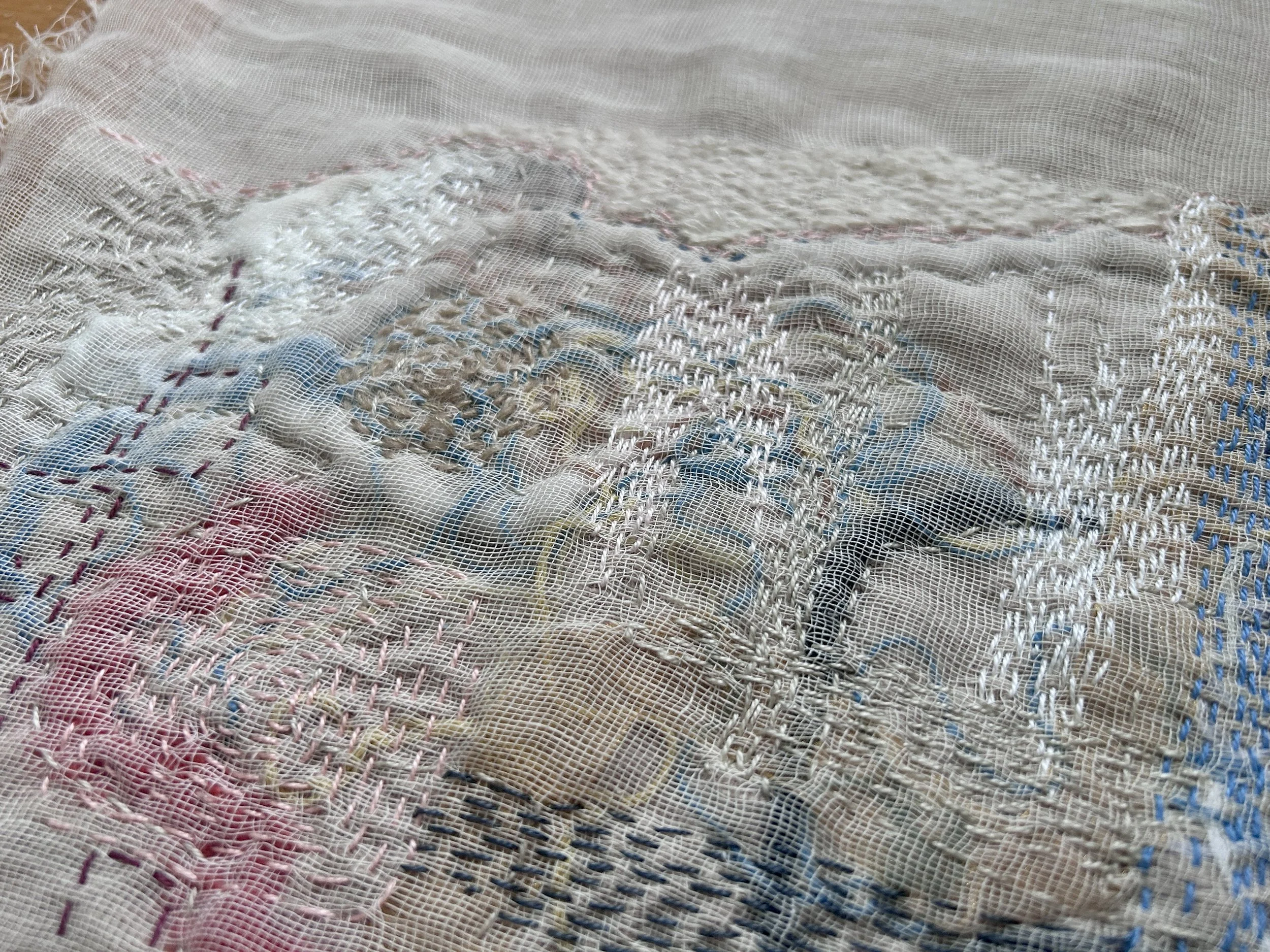
I was reading an article in The Guardian about conversations that have become one-sided.
Somewhere amongst it was a thought about how we may be losing our capacity for conversations that meander without needing to arrive anywhere. Good dialogue depends upon both people being changed, however slightly, by what the other brings.
It made me think about stitching.
When I slow stitch, I rarely begin with a clear picture of where I am going.
I may choose a thread because I like its colour. Begin a line because that part of the cloth catches my attention. Make a few stitches in one direction and then, for no particular reason I can explain, turn.
Something changes.
A line that looked insignificant begins to affect another. A colour becomes louder than I expected. A space I thought I would fill starts to feel better left quiet.
So I look again.
And what happens next grows from what is already there.
That may be why this stitching sometimes feels less like making an image and more like having a conversation.
Not because I imagine the cloth literally speaking back to me.
It is much quieter than that.
I make a mark and the surface changes.
The changed surface affects the next decision.
I respond.
Then it changes again.
There is a reciprocity in it.
If I arrive knowing exactly what the cloth must become, much of that disappears. I can still make something beautiful. I can follow a pattern skilfully, repeat a motif, work towards an image I already understand.
But I am no longer listening in quite the same way.
I am delivering the speech.
There are many ways to stitch, and one is not more worthy than another. Elaborate embroidery can be extraordinary. Repeated traditional patterns can carry skill, history and belonging.
But what interests me at the moment is what happens when I leave enough uncertainty for something else to enter.
A mistake.
An awkward crossing.
A thread that behaves differently from the others.
A change of mind.
An empty place.
The pause matters too.
In conversation, a pause gives someone else room to come in.
Cloth needs that room as well.
Sometimes I put the needle down because I have no idea what comes next. I used to think that meant I had lost the thread.
Now I am less certain.
I may need to look for longer.
The next stitch does not always have to follow immediately from the last one.
There are moments when I realise I have been trying too hard to make something happen. Filling because there is space. Adding another colour because the surface feels unfinished. Continuing a line because I had assumed it would go further.
Then I stop.
Often the work becomes clearer when I stop talking over it.
This is what I mean when I use the word listening around making.
Not waiting for some hidden message.
Not trying to interpret the cloth.
Just letting what has already happened influence what I do next.
A good conversation can wander somewhere neither person expected.
So can a line of thread.
That may be why I keep returning to slow stitching without wanting to decide too much in advance.
I am curious to see where the conversation goes.
And sometimes, where it chooses to stop.